
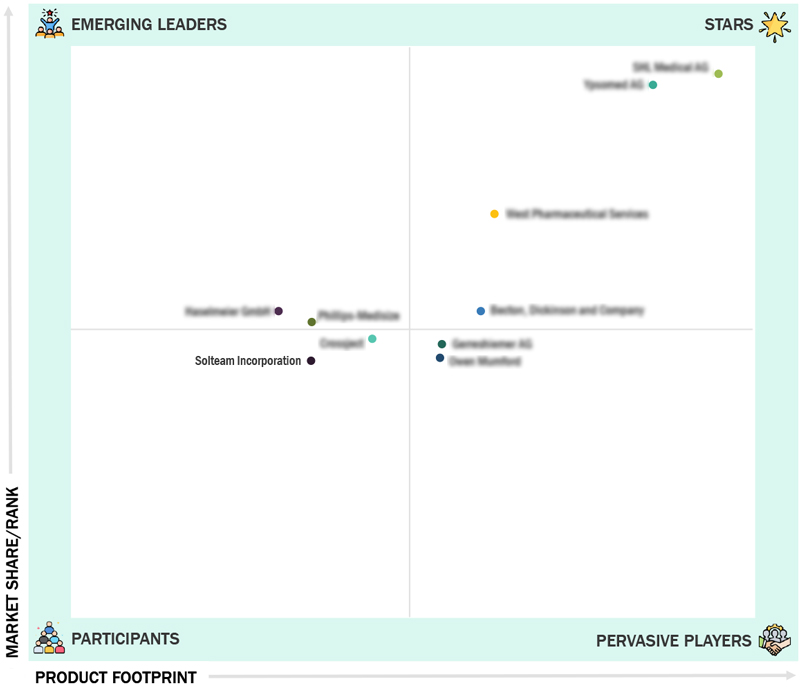
Comparing 10 vendors in Autoinjectors across 0 criteria.
The global autoinjectors market is expected to expand considerably, driven by the increasing prevalence of chronic diseases, including diabetes, autoimmune disorders, and anaphylaxis. The growing adoption of biologics and biosimilars, rising regulatory approvals, and the increasing preference for self-administration and home-based healthcare are further supporting market expansion. Autoinjectors offer greater convenience, ease of use, and improved patient adherence while reducing dependence on hospital and clinical settings. In addition, favorable government initiatives and reimbursement policies in developed markets are contributing to the increasing adoption of these devices. Despite these growth prospects, several challenges may restrain market expansion. The increasing development and adoption of needle-free drug delivery technologies, along with needle phobia among certain patient populations, may limit the use of conventional autoinjectors.
1.1 Study Objectives
1.2 Market Definition
1.3 Study Scope
1.3.1 Segments Considered
1.3.2 Inclusions and Exclusions
1.3.3 Years Considered
1.3.4 Currency Considered
1.5 Stakeholders
1.6 Summary of Changes
2.1 Introduction
2.2 Market Dynamics
2.2.1 Drivers
2.2.1.1 Rising Prevalence of Chronic and Autoimmune Diseases
2.2.1.2 Increasing Regulatory Approvals for Autoinjectors
2.2.1.3 High Demand for Biosimilars and Biologics
2.2.1.4 Growing Adoption of Self-administered Medicines
2.2.1.5 Government Support and Favorable Reimbursement Policies
2.2.2 Restraints
2.2.2.1 Focus on Needle-free Drug Delivery Systems and Prevalence of Needle Phobia
2.2.3 Opportunities
2.2.3.1 Impending Patent Expiry of Biological Molecules
2.2.3.2 Launch of Technologically Advanced Autoinjectors
2.2.3.3 Untapped Opportunities in Emerging Markets
2.2.4 Challenges
2.2.4.1 Development of Autoinjectors for Multiple Drug Viscosities
2.2.4.2 Risk of Device Malfunctions and Recalls
2.3 Unmet Needs and White Spaces
2.3.1 Unmet Needs in Autoinjectors Market
2.3.2 White Space Opportunities
2.4 Interconnected Markets & Cross-sector Opportunities
2.4.1 Interconnected Markets
2.4.2 Cross-sector Opportunities
2.5 Strategic Moves By Tier 1/2/3 Players
2.6 Porter’s Five Forces Analysis
2.6.1 Threat of New Entrants
2.6.2 Threat of Substitutes
2.6.3 Bargaining Power of Suppliers
2.6.4 Bargaining Power of Buyers
2.6.5 Intensity of Competitive Rivalry
2.7 Macroeconomic Outlook
2.7.1 Introduction
2.7.2 GDP Trends and Forecast
2.7.3 Trends in Global Healthcare Industry
2.7.4 Trends in Global Medical Device Industry
2.8 Supply Chain Analysis
2.9 Value Chain Analysis
2.10 Market Ecosystem
2.10.1 Autoinjectors Market Providers
2.10.2 End Users
2.11.3 Regulatory Bodies
2.11 Impact of US Tariffs—Autoinjectors Market
2.11.1 Introduction
2.11.2 Key Tariff Rates
2.11.3 Price Impact Analysis
2.11.4 Impact on Countries/Regions
2.11.4.1 North America
2.11.4.2 Asia Pacific
2.11.4.3 Europe
2.11.4.4 Latin America
2.11.5 Impact on End-Use Segments
2.12 Devices for Large-volume Formulations
2.13 Devices for Highly Viscous Formulations
2.14 Insights on Future Areas of Focus in Autoinjectors Market
3.1 Introduction
3.2 Key Player Strategies/Right to Win, 2022–2026
3.2.1 Overview of Strategies Adopted By Players in Autoinjectors Market
3.3 Revenue Analysis, 2023–2025
3.3.1 Revenue Analysis: Autoinjector Devices Market
3.3.2 Revenue Analysis: Finished Formulation Autoinjectors Market
3.4 Market Share Analysis, 2025
3.4.1 Market Share Analysis: Autoinjector Devices Market
3.4.2 Market Share Analysis: Finished Formulation Autoinjectors Market
3.5 Company Evaluation Matrix: Key Players, 2025
3.5.1 Autoinjector Devices Market
3.5.1.1 Stars
3.5.1.2 Emerging Leaders
3.5.1.3 Pervasive Players
3.5.1.4 Participants
3.5.1.5 Company Footprint: Key Players, 2025
3.5.1.5.1 Company Footprint
3.5.1.5.2 Region Footprint
3.5.1.5.3 Usage Footprint
3.5.1.5.4 Volume Footprint
3.5.1.5.5 Route of Administration Footprint
3.7 Company Valuation and Financial Metrics
3.7.1 Financial Metrics
3.7.2 Company Valuation
3.8 Brand Comparison
3.9 Competitive Scenario
3.9.1 Product Launches & Approvals
3.9.2 Deals
3.9.3 Expansions
3.9.4 Product Launches & Approvals
3.9.5 Deals
3.9.6 Expansions
4.1 SHL MEDICAL AG
4.1.1 Business overview
4.1.2 Products/Solutions/Services offered
4.1.3 Recent developments
4.2 YPSOMED AG
4.2.1 Business overview
4.2.2 Products/Solutions/Services offered
4.2.3 Recent developments
4.3 WEST PHARMACEUTICAL SERVICES, INC
4.3.1 Business overview
4.3.2 Products/Solutions/Services offered
4.3.3 Recent developments
4.4 BECTON, DICKINSON AND COMPANY (BD)
4.4.1 Business overview
4.4.2 Products/Solutions/Services offered
4.4.3 Recent developments
4.5 PHILLIPS-MEDISIZE
4.5.1 Business overview
4.5.2 Products/Solutions/Services offered
4.5.3 Recent developments
4.6 HASELMEIER GMBH
4.6.1 Business overview
4.6.2 Products/Solutions/Services offered
4.6.3 Recent developments
4.7 GERRESHEIMER AG
4.7.1 Business overview
4.7.2 Products/Solutions/Services offered
4.7.3 Recent developments
4.8 OWEN MUMFORD
4.8.1 Business overview
4.8.2 Products/Solutions/Services offered
4.8.3 Recent developments
4.9 CROSSJECT
4.9.1 Business overview
4.9.2 Products/Solutions/Services offered
4.9.3 Recent developments
4.10 SOLTEAM INCORPORATION CO., LTD.
4.10.1 Business overview
4.10.2 Products/Solutions/Services offered
4.10.3 Recent developments


Company Profiles
Strategy, financials, growth, and SWOT
Market Insights
Visual quadrant of competitors and leaders
Benchmarking
Compare by product, region, and end-user
Lead Gen Add-on
Use the quadrant to attract clients
 Anime News Network
 Oct 2026
ad-hoc-news.de
Oct 2026
Zacks Investment Research
Oct 2026
Daily Observer
Oct 2026
Daily Observer
Oct 2026
Dealroom
Oct 2026
The Lakeville Journal
Oct 2026
Respiratory Therapy
Oct 2026
Morningstar
Oct 2026

360 Quadrants is a scientific research methodology by MarketsandMarkets to understand market leaders in 6000+ micro markets
360 Quadrants is a scientific research methodology by MarketsandMarkets to understand market leaders in 6000+ micro markets
Email : [email protected]
Quick Links
360 Quadrants is a scientific research methodology by MarketsandMarkets to understand market leaders in 6000+ micro markets
 Company
 Headquarters
 Year Founded
 Holding Type