
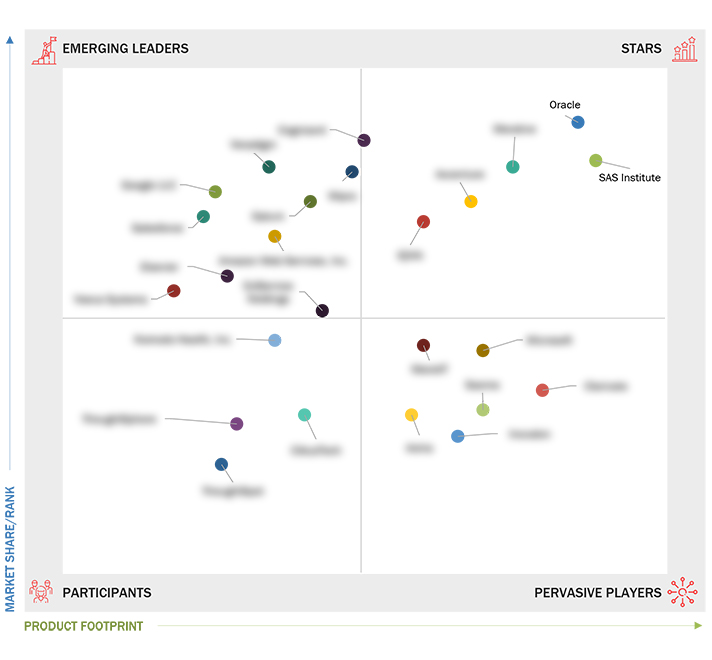
Comparing 25 vendors in Life Science Analytics across 0 criteria.
1 INTRODUCTION

    1.1 Study Objectives
    1.2 Market Definition
    1.3 Study Scope

        1.3.1 Markets Covered and Regional Scope
        1.3.2 Inclusions & Exclusions
        1.3.3 Years Considered
        1.3.4 Currency Considered

    1.4 Stakeholders
    1.5 Summary of Changes


2 MARKET OVERVIEW

    2.1 Introduction
    2.2 Market Dynamics

        2.2.1 Drivers

            2.2.1.1 Rising pressure to curb healthcare spending
            2.2.1.2 Need for improved data standardization
            2.2.1.3 Technological advancements in analytical solutions
            2.2.1.4 Heterogeneity and complexity of big data in life sciences
            2.2.1.5 Growing adoption of analytical solutions in clinical trials
            2.2.1.6 Increasing R&D expenditure in pharmaceutical & bIoTechnology
                    companies

        2.2.2 Restraints

            2.2.2.1 High implementation costs of advanced analytical solutions
            2.2.2.2 Data privacy concerns

        2.2.3 Opportunities

            2.2.3.1 Growing focus on value-based care
            2.2.3.2 Use of analytics in precision & personalized medicine
            2.2.3.3 Big data analytics for R&D productivity
            2.2.3.4 Growing adoption of cloud-based analytics

        2.2.4 Challenges

            2.2.4.1 Issues associated with data integration
            2.2.4.2 Shortage of skilled personnel
            2.2.4.3 Reluctance to adopt life science analytics solutions in
                    emerging countries

    2.3 Industry Trends

        2.3.1 Growing Adoption of Analytics in Commercial Operations
        2.3.2 Leveraging Data & Analytics to Accelerate Drug Discovery &
              Development
        2.3.3 Focus on Real-Time Data Analytics

    2.4 Technology Analysis

        2.4.1 Key Technologies

            2.4.1.1 Artificial intelligence and machine learning
            2.4.1.2 Big data analytics
            2.4.1.3 Quantum computing

        2.4.2 Complementary Technologies

            2.4.2.1 Bioinformatics tools
            2.4.2.2 Internet of Things

        2.4.3 Adjacent Technologies

            2.4.3.1 Blockchain

    2.5 Ecosystem Analysis
    2.6 Value Chain Analysis
    2.7 Porter’s Five Forces Analysis

        2.7.1 Threat of New Entrants
        2.7.2 Threat of Substitutes
        2.7.3 Bargaining Power of Suppliers
        2.7.4 Bargaining Power of Buyers
        2.7.5 Intensity of Competitive Rivalry


3 COMPETITIVE LANDSCAPE

    3.1 Overview
    3.2 Key Player Strategies/Right to Win

        3.2.1 Overview of Strategies Adopted By Players in Life Science
              Analytics Market

    3.3 Revenue Analysis
    3.4 Market Share Analysis
    3.5 Company Evaluation Matrix: Key Players, 2023

        3.5.1 Stars
        3.5.2 Emerging Leaders
        3.5.3 Pervasive Players
        3.5.4 Participants
        3.5.5 Company Footprint: Key Players, 2024

            3.5.5.1 Company footprint
            3.5.5.2 Region footprint
            3.5.5.3 Type footprint
            3.5.5.4 Application footprint
            3.5.5.5 Component footprint
            3.5.5.6 End User footprint

    3.6 Brand/Software Comparative Analysis
    3.7 Company Valuation and Financial Metrics
    3.8 Year-to-Date (YTD) Price Total Return and 5-Year Stock Beta of Life
        Science Analytical Vendors
    3.9 Competitive Scenario

        3.9.1 Product Launches & Enhancements
        3.9.2 Deals


4 COMPANY PROFILES

    4.1 ORACLE

        4.1.1 Business overview
        4.1.2 Products/Solutions/Services offered
        4.1.3 Recent developments

    4.2 MERATIVE

        4.2.1 Business overview
        4.2.2 Products/Solutions/Services offered
        4.2.3 Recent developments

    4.3 SAS INSTITUTE INC.

        4.3.1 Business overview
        4.3.2 Products/Solutions/Services offered
        4.3.3 Recent developments

    4.4 ACCENTURE

        4.4.1 Business overview
        4.4.2 Products/Solutions/Services offered
        4.4.3 Recent developments

    4.5 IQVIA INC.

        4.5.1 Business overview
        4.5.2 Products/Solutions/Services offered
        4.5.3 Recent developments

    4.6 COGNIZANT

        4.6.1 Business overview
        4.6.2 Products/Solutions/Services offered
        4.6.3 Recent developments

    4.7 WIPRO

        4.7.1 Business overview
        4.7.2 Products/Solutions/Services offered
        4.7.3 Recent developments

    4.8 VERADIGM LLC

        4.8.1 Business overview
        4.8.2 Products/Solutions/Services offered
        4.8.3 Recent developments

    4.9 OPTUM, INC.

        4.9.1 Business overview
        4.9.2 Products/Solutions/Services offered
        4.9.3 Recent developments

    4.10 MICROSOFT

        4.10.1 Business overview
        4.10.2 Products/Solutions/Services offered
        4.10.3 Recent developments

    4.11 MAXISIT

        4.11.1 Business overview
        4.11.2 Products/Solutions/Services offered
        4.11.3 Recent developments

    4.12 EXLSERVICE HOLDINGS, INC.

        4.12.1 Business overview
        4.12.2 Products/Solutions/Services offered
        4.12.3 Recent developments

    4.13 INOVALON

        4.13.1 Business overview
        4.13.2 Products/Solutions/Services offered
        4.13.3 Recent developments

    4.14 CITIUSTECH INC.

        4.14.1 Business overview
        4.14.2 Products/Solutions/Services offered
        4.14.3 Recent developments

    4.15 SAAMA

        4.15.1 Business overview
        4.15.2 Products/Solutions/Services offered
        4.15.3 Recent developments

    4.16 AXTRIA

        4.16.1 Business overview
        4.16.2 Products/Solutions/Services offered
        4.16.3 Recent developments

    4.17 CLARIVATE

        4.17.1 Business overview
        4.17.2 Products/Solutions/Services offered
        4.17.3 Recent developments

    4.18 THOUGHTSPHERE

        4.18.1 Business overview
        4.18.2 Products/Solutions/Services offered
        4.18.3 Recent developments

    4.19 THOUGHTSPOT INC.

        4.19.1 Business overview
        4.19.2 Products/Solutions/Services offered
        4.19.3 Recent developments

    4.20 SALESFORCE, INC.

        4.20.1 Business overview
        4.20.2 Products/Solutions/Services offered
        4.20.3 Recent developments

    4.21 GOOGLE LLC

        4.21.1 Business overview
        4.21.2 Products/Solutions/Services offered
        4.21.3 Recent developments

    4.22 AMAZON WEB SERVICES, INC.

        4.22.1 Business overview
        4.22.2 Products/Solutions/Services offered
        4.22.3 Recent developments

    4.23 VEEVA SYSTEMS

        4.23.1 Business overview
        4.23.2 Products/Solutions/Services offered
        4.23.3 Recent developments

    4.24 ELSEVIER

        4.24.1 Business overview
        4.24.2 Products/Solutions/Services offered
        4.24.3 Recent developments

    4.25 KOMODO HEALTH, INC.

        4.25.1 Business overview
        4.25.2 Products/Solutions/Services offered
        4.25.3 Recent developments


Company Profiles
Strategy, financials, growth, and SWOT
Market Insights
Visual quadrant of competitors and leaders
Benchmarking
Compare by product, region, and end-user
Lead Gen Add-on
Use the quadrant to attract clients
 WebWire
 Sep 2026
Tech Wire Asia
Sep 2026
Healthcare IT News
Sep 2026
Consultancy-me.com
Sep 2026
Procurement Magazine
Aug 2026
Seeking Alpha
Aug 2026
Logistics Management
Aug 2026
Sep 2026
Tech Wire Asia
Sep 2026
Healthcare IT News
Sep 2026
Consultancy-me.com
Sep 2026
Procurement Magazine
Aug 2026
Seeking Alpha
Aug 2026
Logistics Management
Aug 2026
Life science analytics refers to the use of data analysis, statistical tools, and predictive models to extract insights from biological, clinical, and healthcare data. It supports decision-making in areas like drug development, patient care, and market strategy.
Industries such as pharmaceuticals, biotechnology, medical devices, healthcare providers, and research institutions rely heavily on life science analytics.
It accelerates the drug development process by identifying potential drug candidates, optimizing clinical trials, and analyzing patient data for safety and efficacy.
By analyzing patient data, it helps in early disease detection, personalized treatment plans, and monitoring treatment efficacy, leading to better patient care.
The future involves more integration of AI, real-time analytics, and personalized medicine, alongside broader adoption of digital health tools and IoT for data collection and analysis.

360 Quadrants is a scientific research methodology by MarketsandMarkets to understand market leaders in 6000+ micro markets
360 Quadrants is a scientific research methodology by MarketsandMarkets to understand market leaders in 6000+ micro markets
Email : [email protected]
Quick Links
360 Quadrants is a scientific research methodology by MarketsandMarkets to understand market leaders in 6000+ micro markets
 Company
 Headquarters
 Year Founded
 Holding Type