
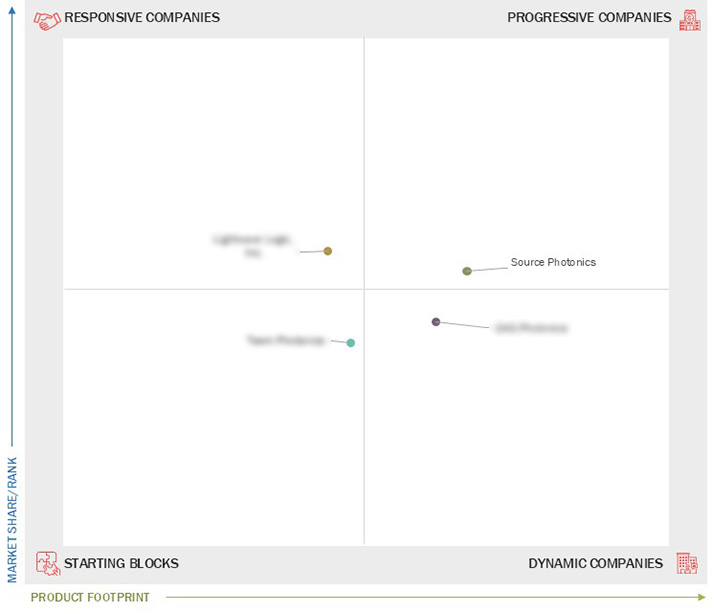
Comparing 4 vendors in Silicon Photonics Startups across 0 criteria.
Silicon photonics technology integrates photonic functionalities (such as lasers, modulators, and detectors) onto silicon-based substrates, enabling faster and more energy-efficient data transfer compared to traditional electronic circuits. This technology is increasingly being adopted in data centres, high-performance computing (HPC), and telecommunications, driven by the explosive growth of data traffic and the need for higher bandwidth and lower power consumption. The key components in the silicon photonics market include transceivers, switches, sensors, and optical engines.
1.1 Study Objectives
1.2 Market Definition
1.3 Study Scope
1.3.1 Markets Covered and Regional Scope
1.3.2 Inclusions and Exclusions
1.3.3 Years Considered
1.4 Currency Considered
1.5 Unit Considered
1.6 Limitations
1.7 Stakeholders
2.1 Introduction
2.2 Market Dynamics
2.2.1 Drivers
2.2.1.1 Surging demand for CMOS-integrated silicon photonics
2.2.1.2 Growing focus on energy efficiency and lower power costs
2.2.1.3 Rising demand for high bandwidth and fast data transfer
2.2.1.4 Expansion of broadband services
2.2.2 Restraints
2.2.2.1 Complexities of integrating laser sources on silicon chips
2.2.3 Opportunities
2.2.3.1 Government funding for developing advanced silicon photonics-based products
2.2.3.2 Expansion of 5G networks
2.2.3.3 Expanding applications of silicon photonics
2.2.3.4 Increasing Use of silicon photonics in short-distance communication
2.2.4 Challenges
2.2.4.1 Inefficient electroluminescence of bulk crystalline silicon
2.2.4.2 Thermal challenges in device miniaturization and complexity
2.3 Trends/Disruptions Impacting Customer Business
2.4 Value Chain Analysis
2.5 Ecosystem Analysis
2.6 Investment and Funding Scenario
2.7 Technology Analysis
2.7.1 Key Technologies
2.7.2 Complementary Technologies
2.7.3 Adjacent Technologies
2.8 Patent Analysis
2.9 Trade Analysis
2.10 Porter’s Five Forces Analysis
2.10.1 Threat of New Entrants
2.10.2 Threat of Substitutes
2.10.3 Bargaining Power of Suppliers
2.10.4 Bargaining Power of Buyers
2.10.5 Intensity of Competitive Rivalry
3.1 Introduction
3.2 Key Player Strategies/Right to Win
3.3 Revenue Analysis
3.4 Market Share Analysis
3.5 Company Valuation and Financial Metrics
3.6 Brand/Product Comparison
3.7 Company Evaluation Matrix: Startups/SMEs
3.7.1 Progressive Companies
3.7.2 Responsive Companies
3.7.3 Dynamic Companies
3.7.4 Starting Blocks
3.7.5 Competitive Benchmarking: Startups/SMEs
3.7.5.1 Detailed list of key startups/SMEs
3.7.5.2 Competitive benchmarking of key startups/SMEs
3.8 Competitive Scenario
3.8.1 Product Launches
3.8.2 Deals
3.8.3 Expansions
3.8.4 Other Developments
4.1 Source Photonics
4.1.1 Business overview
4.1.2 Products/Solutions/Services offered
4.1.3 Recent developments
4.2 Lightwave Logic, Inc.
4.2.1 Business overview
4.2.2 Products/Solutions/Services offered
4.2.3 Recent developments
4.3 DAS Photonics
4.3.1 Business overview
4.3.2 Products/Solutions/Services offered
4.3.3 Recent developments
4.4 Teem Photonics
4.4.1 Business overview
4.4.2 Products/Solutions/Services offered
4.4.3 Recent developments


Company Profiles
Strategy, financials, growth, and SWOT
Market Insights
Visual quadrant of competitors and leaders
Benchmarking
Compare by product, region, and end-user
Lead Gen Add-on
Use the quadrant to attract clients
 marketbeat
 Mar 2026
Lightwave Logic, Inc.
Mar 2025
Lightwave Logic, Inc.
Jan 2025
Lightwave Logic, Inc.
Jan 2025
Mar 2026
Lightwave Logic, Inc.
Mar 2025
Lightwave Logic, Inc.
Jan 2025
Lightwave Logic, Inc.
Jan 2025

360 Quadrants is a scientific research methodology by MarketsandMarkets to understand market leaders in 6000+ micro markets
360 Quadrants is a scientific research methodology by MarketsandMarkets to understand market leaders in 6000+ micro markets
Email : [email protected]
Quick Links
360 Quadrants is a scientific research methodology by MarketsandMarkets to understand market leaders in 6000+ micro markets
 Company
 Headquarters
 Year Founded
 Holding Type