
Comparing 19 vendors in Cloud Security across 0 criteria.
Cloud security has become a fundamental component of modern cybersecurity strategies, enabling organizations to protect cloud infrastructure, applications, workloads, identities, and data across increasingly distributed environments. As enterprises accelerate their migration to cloud platforms, security teams are required to address a broader and more dynamic threat landscape while maintaining visibility and control across their digital infrastructure. The cloud security market encompasses a broad range of technologies and solutions designed to secure cloud-based environments. Key capabilities include cloud security posture management (CSPM), cloud workload protection, identity and access management, data security, threat detection, and security analytics. These technologies help organizations identify vulnerabilities, enforce security policies, and protect critical resources across cloud environments. Cloud-Native Application Protection Platforms (CNAPP) are becoming increasingly important as organizations adopt cloud-native application development and DevSecOps practices.
1.1 Study Objectives
1.2 Market Definition
1.3 Study Scope and Segmentation
1.3.1 Market Segmentation
1.3.2 Inclusions and Exclusions
1.4 Years Considered
1.5 Currency Considered
1.6 Stakeholders
1.7 Summary of Changes
2.1 Introduction
2.2 Market Dynamics
2.2.1 Drivers
2.2.1.1 Increasing Adoption of Multi-cloud and Hybrid Cloud Environments
2.2.1.2 Growth of Devsecops and Cloud-native Development Practices
2.2.1.3 Rising Frequency and Sophistication of Cyber Threats
2.2.1.4 Stringent Regulatory and Data Protection Requirements
2.2.2 Restraints
2.2.2.1 Complexity in Managing Multi-cloud Security Environments
2.2.2.2 High Implementation and Operational Costs
2.2.3 Opportunities
2.2.3.1 Expansion of Cloud Computing and Digital Transformation Initiatives
2.2.3.2 Growth of Mobile Computing and Remote Workforce Models
2.2.3.3 Increasing Adoption of IoT and Connected Devices
2.2.3.4 Shift toward Zero Trust and Identity-first Security Models
2.2.4 Challenges
2.2.4.1 Shortage of Skilled Cloud Security Professionals
2.2.4.2 Limited Visibility and Control across Distributed Cloud Environments
2.3 Unmet Needs and White Spaces
2.4 Interconnected Markets and Cross-sector Opportunities
2.4.1 Interconnected Markets
2.4.2 Cross-sector Opportunities
2.5 Strategic Moves By Tier-1/2/3 Players
2.5.1 Cross-tier Strategic Patterns
2.5.2 Strategic Trends
2.5.2.1 Adoption of Zero Trust and Identity centric Security
2.5.2.2 AI- and Ml-driven Cloud Security
2.5.2.3 Growth of Cloud-native and Continuous Security
2.6 Porter’s Five Forces Analysis
2.6.1 Threat of New Entrants
2.6.2 Threat of Substitutes
2.6.3 Bargaining Power of Suppliers
2.6.4 Bargaining Power of Buyers
2.6.5 Intensity of Competitive Rivalry
2.7 Macroeconomic Indicators
2.7.1 Introduction
2.7.2 GDP Trends and Forecast
2.7.3 Trends in Global Ict Industry
2.7.4 Trends in Global Cybersecurity Industry
2.8 Value Chain Analysis
2.9 Ecosystem
2.10 Key Conferences and Events in 2026-2027
2.11 Trends and Disruptions Impacting Customer Business
2.12 Investment and Funding Scenario
3.1 Key Player Strategies/Right to Win, 2023-2026
3.2 Revenue Analysis, 2021-2025
3.3 Market Share Analysis, 2025
3.4 Brand Comparison
3.5 Company Valuation and Financial Metrics
3.5.1 Company Valuation, 2026
3.5.2 Financial Metrics Using Ev/Ebidta, 2026
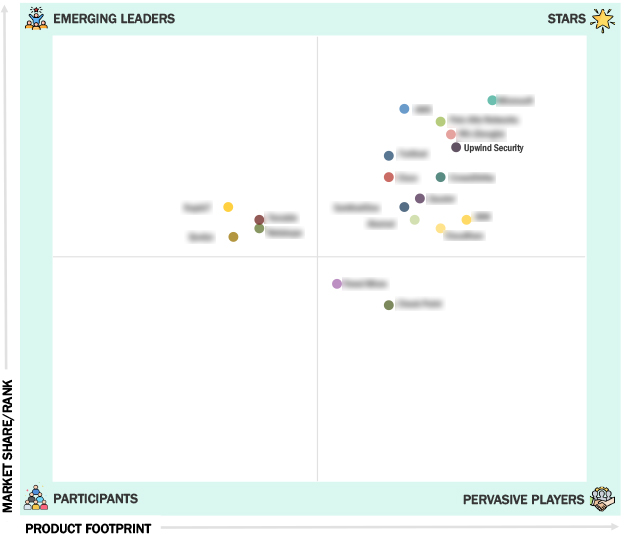
3.6 Company Evaluation Matrix: Key Players, 2025
3.6.1 Stars
3.6.2 Emerging Leaders
3.6.3 Pervasive Players
3.6.4 Participants
3.6.5 Company Footprint: Key Players, 2025
3.6.5.1 Company Footprint
3.6.5.2 Offering Footprint
3.6.5.3 Deployment Mode Footprint
3.6.5.4 Vertical Footprint
3.6.5.5 Regional Footprint
3.8 Competitive Scenario and Trends
3.8.1 Product Launches and Enhancements
3.8.2 Deals
4.1 MICROSOFT
4.1.1 Business overview
4.1.2 Products/Solutions/Services offered
4.1.3 Recent developments
4.2 AWS
4.2.1 Business overview
4.2.2 Products/Solutions/Services offered
4.2.3 Recent developments
4.3 PALO ALTO NETWORKS
4.3.1 Business overview
4.3.2 Products/Solutions/Services offered
4.3.3 Recent developments
4.4 WIZ
4.4.1 Business overview
4.4.2 Products/Solutions/Services offered
4.4.3 Recent developments
4.5 UPWIND SECURITY
4.5.1 Business overview
4.5.2 Products/Solutions/Services offered
4.5.3 Recent developments
4.6 FORTINET
4.6.1 Business overview
4.6.2 Products/Solutions/Services offered
4.6.3 Recent developments
4.7 CROWDSTRIKE
4.7.1 Business overview
4.7.2 Products/Solutions/Services offered
4.7.3 Recent developments
4.8 CISCO
4.8.1 Business overview
4.8.2 Products/Solutions/Services offered
4.8.3 Recent developments
4.9 ZSCALER
4.9.1 Business overview
4.9.2 Products/Solutions/Services offered
4.9.3 Recent developments
4.10 SENTINELONE
4.10.1 Business overview
4.10.2 Products/Solutions/Services offered
4.10.3 Recent developments
4.11 IBM
4.11.1 Business overview
4.11.2 Products/Solutions/Services offered
4.11.3 Recent developments
4.12 AKAMAI
4.12.1 Business overview
4.12.2 Products/Solutions/Services offered
4.12.3 Recent developments
4.13 CLOUDFLARE
4.13.1 Business overview
4.13.2 Products/Solutions/Services offered
4.13.3 Recent developments
4.14 NETSKOPE
4.14.1 Business overview
4.14.2 Products/Solutions/Services offered
4.14.3 Recent developments
4.15 TENABLE
4.15.1 Business overview
4.15.2 Products/Solutions/Services offered
4.15.3 Recent developments
4.16 QUALYS
4.16.1 Business overview
4.16.2 Products/Solutions/Services offered
4.16.3 Recent developments
4.17 RAPID7
4.17.1 Business overview
4.17.2 Products/Solutions/Services offered
4.17.3 Recent developments
4.18 CHECK POINT
4.18.1 Business overview
4.18.2 Products/Solutions/Services offered
4.18.3 Recent developments
4.19 TREND MICRO
4.19.1 Business overview
4.19.2 Products/Solutions/Services offered
4.19.3 Recent developments


Company Profiles
Strategy, financials, growth, and SWOT
Market Insights
Visual quadrant of competitors and leaders
Benchmarking
Compare by product, region, and end-user
Lead Gen Add-on
Use the quadrant to attract clients
 https://tech-insider.org/
 Sep 2026
The Motley Fool
Sep 2026
Morningstar
Sep 2026
Sep 2026
The Motley Fool
Sep 2026
Morningstar
Sep 2026

360 Quadrants is a scientific research methodology by MarketsandMarkets to understand market leaders in 6000+ micro markets
360 Quadrants is a scientific research methodology by MarketsandMarkets to understand market leaders in 6000+ micro markets
Email : [email protected]
Quick Links
360 Quadrants is a scientific research methodology by MarketsandMarkets to understand market leaders in 6000+ micro markets
 Company
 Headquarters
 Year Founded
 Holding Type