
Comparing 8 vendors in ESG Reporting Software Stratups across 0 criteria.
The ESG Reporting Software market has evolved from a voluntary disclosure tool into a critical compliance and enterprise data management solution, driven by regulations such as the EU CSRD and ISSB standards. The market is experiencing strong growth, supported by increasing demand for auditable and transparent sustainability reporting. North America and Europe currently lead market adoption, while Asia-Pacific is emerging as the fastest-growing region. Cloud-based platforms dominate due to their scalability, flexibility, and ability to adapt to changing regulatory requirements. AI-powered automation, real-time data integration, and audit-ready reporting capabilities are transforming ESG data management and reducing manual errors. Demand for double materiality assessments and Scope three emissions tracking is further accelerating software adoption.
1.1 Study Objectives
1.2 Market Definition
1.2.1 Inclusions and Exclusions
1.3 Study Scope
1.3.1 Market Segmentation
1.3.2 Regions Covered
1.4 Years Considered
1.5 Currency Considered
1.6 Stakeholders
1.7 Summary of Changes
1.7.1 Recession Impact
2.1 Introduction
2.2 Market Dynamics
2.2.1 Drivers
2.2.1.1 Consistent growth in corporate data volume
2.2.1.2 Proliferation in growth of credible corporate disclosures
2.2.1.3 Emphasis on automated data collection, reporting, and reduced manual efforts
2.2.1.4 Growing demand for navigating and mitigating ESG risks
2.2.2 Restraints
2.2.2.1 Huge initial capital expenditure
2.2.2.2 Regulatory uncertainty hindering adoption and expansion of ESG reporting software
2.2.3 Opportunities
2.2.3.1 Climate testing to gain traction among financial service organizations
2.2.3.2 Assessment of natural capital and biodiversity risks to grow significantly
2.2.3.3 Enhancing sustainability through integration with enterprise systems
2.2.4 Challenges
2.2.4.1 Inadequate management practices and lack of skilled workforce
2.2.4.2 Rising pressure on corporate boards and government leaders to enhance ESG skills
2.3 Ecosystem Analysis
2.4 Value Chain Analysis
2.5 Patent Analysis
2.6 Technology Analysis
2.6.1 Key Technologies
2.6.1.1 Cloud computing
2.6.1.2 Data analytics and business intelligence tools
2.6.2 Adjacent Technologies
2.6.2.1 AI/ML
2.6.2.2 Blockchain
2.6.3 Complementary Technologies
2.6.3.1 IoT
2.6.3.2 Cybersecurity
2.7 Porter’s Five Forces Analysis
2.7.1 Threat of New Entrants
2.7.2 Threat of Substitutes
2.7.3 Bargaining Power of Suppliers
2.7.4 Bargaining Power of Buyers
2.7.5 Intensity of Competitive Rivalry
2.8 Trends/Disruptions Impacting Customer Business
2.9 Key Conferences and Events, 2024–2025
2.10 Business Model Analysis
2.10.1 Subscription-Based Model
2.10.2 Pay-Per-Use Model
2.10.3 Enterprise Licensing Model
2.10.4 Freemium Model
2.10.5 Enterprise Licensing Model
2.11 Investment & Funding Scenario
3.1 Overview
3.2 Revenue Analysis
3.3 Market Share Analysis
3.4 Brand/Product Comparison
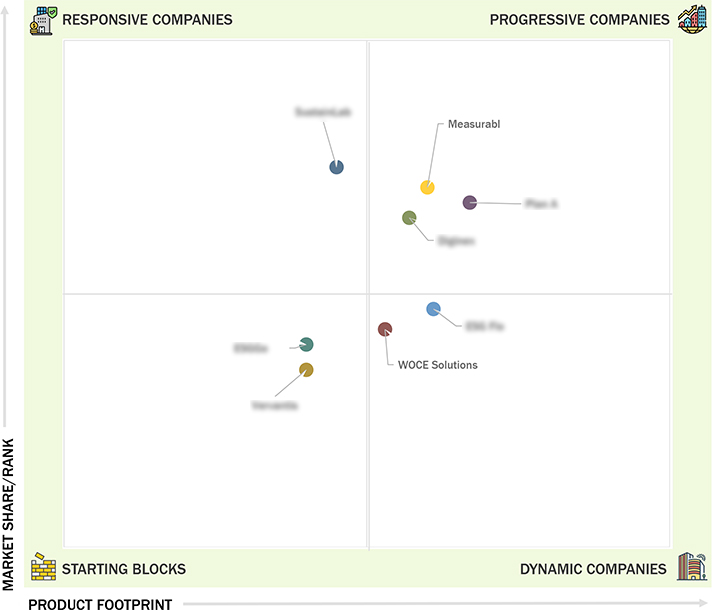
3.5 Company Evaluation Matrix: Start-Ups/Smes, 2023
3.5.1 Progressive Companies
3.5.2 Responsive Companies
3.5.3 Dynamic Companies
3.5.4 Starting Blocks
3.5.5 Competitive Benchmarking: Start-Ups/Smes, 2023
3.6 Company Valuation and Financial Metrics
3.7 Competitive Scenario and Trends
3.7.1 Product Launches and Enhancements
3.7.2 Deals
4.1 ESG FLO
4.1.1 Business overview
4.1.2 Products/Solutions/Services offered
4.1.3 Recent developments
4.2 MEASURABL
4.2.1 Business overview
4.2.2 Products/Solutions/Services offered
4.2.3 Recent developments
4.3 PLAN A
4.3.1 Business overview
4.3.2 Products/Solutions/Services offered
4.3.3 Recent developments
4.4 SUSTAINLAB
4.4.1 Business overview
4.4.2 Products/Solutions/Services offered
4.4.3 Recent developments
4.5 ESGGO
4.5.1 Business overview
4.5.2 Products/Solutions/Services offered
4.5.3 Recent developments
4.6 WOCE
4.6.1 Business overview
4.6.2 Products/Solutions/Services offered
4.6.3 Recent developments
4.7 VERVANTIS
4.7.1 Business overview
4.7.2 Products/Solutions/Services offered
4.7.3 Recent developments
4.8 DIGINEX
4.8.1 Business overview
4.8.2 Products/Solutions/Services offered
4.8.3 Recent developments


Company Profiles
Strategy, financials, growth, and SWOT
Market Insights
Visual quadrant of competitors and leaders
Benchmarking
Compare by product, region, and end-user
Lead Gen Add-on
Use the quadrant to attract clients
 ESG News
 Oct 2025
TradingView
Sep 2025
FinTech Global
Aug 2025
Oct 2025
TradingView
Sep 2025
FinTech Global
Aug 2025

360 Quadrants is a scientific research methodology by MarketsandMarkets to understand market leaders in 6000+ micro markets
360 Quadrants is a scientific research methodology by MarketsandMarkets to understand market leaders in 6000+ micro markets
Email : [email protected]
Quick Links
360 Quadrants is a scientific research methodology by MarketsandMarkets to understand market leaders in 6000+ micro markets
 Company
 Headquarters
 Year Founded
 Holding Type