
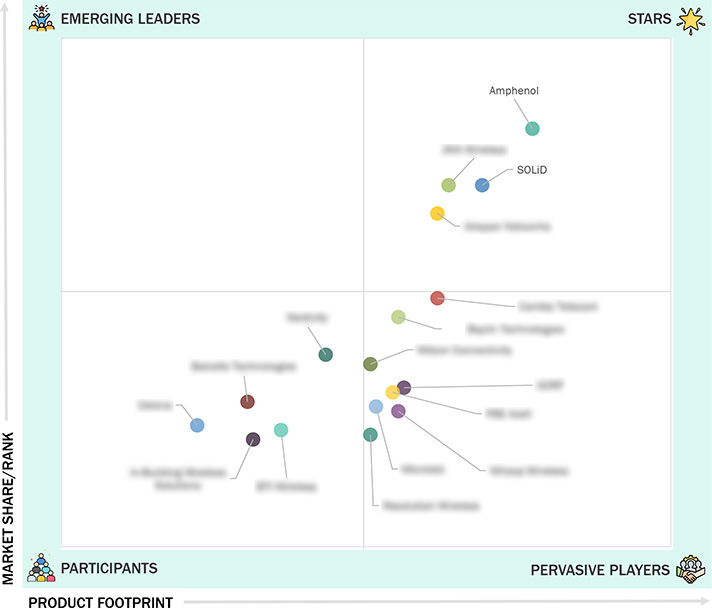
Comparing 17 vendors in In-building Wireless across 0 criteria.
The in-building wireless market focuses on providing strong and reliable cellular and data connectivity within indoor environments where outdoor network signals are insufficient. It plays a critical role as mobile data consumption continues to rise and users expect uninterrupted connectivity indoors. The market is driven by rapid adoption of smartphones, cloud services, and bandwidth-intensive applications. Deployment of 5G networks has further accelerated demand for advanced indoor wireless solutions. Key technologies include Distributed Antenna Systems (DAS), small cells, and signal repeaters. These solutions are widely used to improve coverage, capacity, and network quality inside commercial buildings such as offices, malls, hotels, and airports represent major application areas.
1.1 Study Objectives
1.2 Market Definition
1.3 Study Scope
1.3.1 Market Segmentation and Regions Covered
1.3.2 Inclusions & Exclusions
1.4 Years Considered
1.5 Currency Considered
1.6 Stakeholders
1.7 Summary of Changes
2.1 Introduction
2.2 Market Dynamics
2.2.1 Drivers
2.2.1.1 Demand for network coverage and capacity
2.2.1.2 Requirement for modern and sustainable concepts of
construction
2.2.1.3 Need to support mission-critical applications
2.2.1.4 Lack of investments from carriers in large venues
2.2.1.5 Public safety requirements in buildings
2.2.1.6 Rapid technological advancements
2.2.2 Restraints
2.2.2.1 Cost constraints concerning equipment
2.2.2.2 Backhaul connectivity issues
2.2.3 Opportunities
2.2.3.1 Deployment of 5G networks
2.2.3.2 Rise of IoT and smart buildings
2.2.4 Challenges
2.2.4.1 Integration with existing infrastructure
2.2.4.2 Security and privacy concerns
2.2.4.3 Interference and signal degradation
2.3 Brief History of In-Building Wireless Solutions and Services
2.3.1 2000–2010
2.3.2 2010–2020
2.3.3 2020–Present
2.4 Ecosystem Analysis
2.5 Technology Analysis
2.5.1 Key Technologies
2.5.1.1 Distributed antenna systems (DAS)
2.5.1.2 Small cell networks
2.5.1.3 Wi-Fi
2.5.2 Adjacent Technologies
2.5.2.1 Passive Optical LAN (POL)
2.5.2.2 LiFi
2.5.3 Complementary Technologies
2.5.3.1 Internet of Things (IoT)
2.5.3.2 WiMAX
2.6 Patent Analysis
2.7 Porter’s Five Forces Analysis
2.7.1 Threat of New Entrants
2.7.2 Threat of Substitutes
2.7.3 Bargaining Power of Buyers
2.7.4 Bargaining Power of Suppliers
2.7.5 Intensity of Competitive Rivalry
2.8 Trends/Disruptions Impacting Customer Business
2.9 Key Conferences and Events, 2025–2026
2.10 Technology Roadmap for In-Building Wireless Market
2.10.1 Short-Term Roadmap (2025–2026)
2.10.2 Mid-Term Roadmap (2027–2028)
2.10.3 Long-Term Roadmap (2029–2030)
2.11 Trade Analysis
2.11.1 Export Scenario (HS Code 8529)
2.11.2 Import Scenario (HS Code 8529)
2.12 Current and Emerging Business Models
2.12.1 Carrier-Driven Model
2.12.2 Enterprise-Owned Model
2.12.3 Neutral Host-Operator Model
2.12.4 Managed Service Provider (MSP) Model
2.12.5 Hybrid Model
2.12.6 Small Cell-as-a-Service (SCAAS) Model
2.13 Best Practices in In-Building Wireless Market
2.14 Tools, Frameworks, and Techniques
2.15 Impact of Generative Ai on In-Building Wireless Market
2.15.1 Top Use Cases and Market Potential
2.15.2 Key Use Cases
2.16 Investment and Funding Scenario
3.1 Introduction
3.2 Key Player Strategies/Right to Win, 2022–2025
3.3 Market Share Analysis, 2024
3.4 Revenue Analysis, 2020–2024
3.5 Company Evaluation Matrix: Key Players, 2024
3.5.1 Stars
3.5.2 Emerging Leaders
3.5.3 Pervasive Players
3.5.4 Participants
3.5.5 Company Footprint: Key Players, 2024
3.5.5.1 Company footprint
3.5.5.2 Region footprint
3.5.5.3 Offering footprint
3.5.5.4 End User footprint
3.6 Brand/ Product Comparison
3.7 Company Valuation and Financial Metrics
3.8 Competitive Scenario
3.8.1 Product Launches
3.8.2 Deals
4.1 AMPHENOL CORPORATION
4.1.1 Business overview
4.1.2 Products/Solutions/Services offered
4.1.3 Recent developments
4.2 JMA WIRELESS
4.2.1 Business overview
4.2.2 Products/Solutions/Services offered
4.2.3 Recent developments
4.3 SOLID
4.3.1 Business overview
4.3.2 Products/Solutions/Services offered
4.3.3 Recent developments
4.4 AIRSPAN NETWORKS
4.4.1 Business overview
4.4.2 Products/Solutions/Services offered
4.4.3 Recent developments
4.5 COMBA TELECOM
4.5.1 Business overview
4.5.2 Products/Solutions/Services offered
4.5.3 Recent developments
4.6 BAYLIN TECHNOLOGIES
4.6.1 Business overview
4.6.2 Products/Solutions/Services offered
4.6.3 Recent developments
4.7 WILSON CONNECTIVITY
4.7.1 Business overview
4.7.2 Products/Solutions/Services offered
4.7.3 Recent developments
4.8 ADRF
4.8.1 Business overview
4.8.2 Products/Solutions/Services offered
4.8.3 Recent developments
4.9 PBE AXELL
4.9.1 Business overview
4.9.2 Products/Solutions/Services offered
4.9.3 Recent developments
4.10 WHOOP WIRELESS
4.10.1 Business overview
4.10.2 Products/Solutions/Services offered
4.10.3 Recent developments
4.11 RESOLUTION WIRELESS
4.11.1 Business overview
4.11.2 Products/Solutions/Services offered
4.11.3 Recent developments
4.12 MICROLAB
4.12.1 Business overview
4.12.2 Products/Solutions/Services offered
4.12.3 Recent developments
4.13 NEXTIVITY
4.13.1 Business overview
4.13.2 Products/Solutions/Services offered
4.13.3 Recent developments
4.14 CELONA
4.14.1 Business overview
4.14.2 Products/Solutions/Services offered
4.14.3 Recent developments
4.15 BTI WIRELESS
4.15.1 Business overview
4.15.2 Products/Solutions/Services offered
4.15.3 Recent developments
4.16 IN-BUILDING WIRELESS SOLUTIONS
4.16.1 Business overview
4.16.2 Products/Solutions/Services offered
4.16.3 Recent developments
4.17 BAICELLS TECHNOLOGIES
4.17.1 Business overview
4.17.2 Products/Solutions/Services offered
4.17.3 Recent developments


Company Profiles
Strategy, financials, growth, and SWOT
Market Insights
Visual quadrant of competitors and leaders
Benchmarking
Compare by product, region, and end-user
Lead Gen Add-on
Use the quadrant to attract clients
 marketbeat
 Mar 2026
marketbeat
Feb 2026
marketbeat
Jan 2026
TelecomLead
Jan 2026
marketbeat
Dec 2025
Mar 2026
marketbeat
Feb 2026
marketbeat
Jan 2026
TelecomLead
Jan 2026
marketbeat
Dec 2025

360 Quadrants is a scientific research methodology by MarketsandMarkets to understand market leaders in 6000+ micro markets
360 Quadrants is a scientific research methodology by MarketsandMarkets to understand market leaders in 6000+ micro markets
Email : [email protected]
Quick Links
360 Quadrants is a scientific research methodology by MarketsandMarkets to understand market leaders in 6000+ micro markets
 Company
 Headquarters
 Year Founded
 Holding Type