
Comparing 24 vendors in Learning Management System across 117 criteria.
Learning Management Systems (LMSs) are digital platforms designed to create, deliver, manage, and track educational and training content in a structured and scalable manner. LMS solutions are widely used across K-12 education, higher education, corporate training, government, and healthcare sectors to streamline learning processes and monitor learner performance. The growing adoption of e-learning, remote training, and digital education initiatives is driving demand for LMS solutions globally. These platforms support personalized learning paths, compliance training, workforce upskilling, reskilling, assessments, analytics, and interactive content delivery. Cloud-based deployment, mobile learning, artificial intelligence (AI), and advanced data analytics are further enhancing LMS functionality, accessibility, and scalability.
1.1 Study Objectives
1.2 Market Definition
1.3 Study Scope and Segmentation
1.3.1 Market Segmentation
1.3.2 Inclusions & Exclusions
1.3.3 Years Considered
1.4 Currency Considered
1.5 Stakeholders
1.6 Summary of Changes
2.1 Introduction
2.2 Market Dynamics
2.2.1 Drivers
2.2.1.1 Increasing adoption of digital and remote learning
2.2.1.2 Growing focus on workforce upskilling and reskilling
2.2.1.3 Rising preference for scalable and budget-friendly learning systems
2.2.1.4 Technological advancements driving cloud-based and mobile LMS solutions
2.2.2 Restraints
2.2.2.1 Resistance to technology adoption among educators and employees
2.2.2.2 Insufficient support for emerging content formats
2.2.3 Opportunities
2.2.3.1 Integration of generative AI and chatbots for learning support
2.2.3.2 Expansion in corporate compliance and certification programs
2.2.3.3 Growing demand for gamification and immersive learning
2.2.3.4 Accelerating shift toward cloud-native multi-tenant LMS platforms
2.2.4 Challenges
2.2.4.1 Data privacy and security concerns
2.2.4.2 High cost of customization and maintenance
2.3 Unmet Needs and White Spaces
2.4 Interconnected Markets and Cross-Sector Opportunities
2.4.1 Interconnected Markets
2.4.2 Cross-Sector Opportunities
2.5 Strategic Moves By Tier -1/2/3 Players
2.5.1 Cross-Tier Strategic Patterns
2.5.2 Strategic Trends
2.5.2.1 Embedding LMS into broader digital credentials and blockchain ecosystems
2.5.2.2 LMS as collaborative, social learning networks
2.5.2.3 Strategic integration of LMS with workflows and enterprise tools
2.6 Porter’s Five Forces Analysis
2.6.1 Threat of New Entrants
2.6.2 Threat of Substitutes
2.6.3 Bargaining Power of Suppliers
2.6.4 Bargaining Power of Buyers
2.6.5 Intensity of Competitive Rivalry
2.7 Macroeconomic Indicators
2.7.1 Introduction
2.7.2 GDP Trends and Forecast
2.7.3 Trends in Global Ict Industry
2.7.4 Trends in Global Edtech Industry
2.8 Value Chain Analysis
2.8.1 Research & Development
2.8.2 Software Development & Lms Platform Services
2.8.3 Content Development & Learning Solutions
2.8.4 System Integration & Customization
2.8.5 Infrastructure Deployment
2.8.6 End User Industries
2.9 Ecosystem Analysis
2.10 Key Conferences & Events, 2026
2.11 Trends and Disruptions Impacting Customer Business
2.12 Investment and Funding Scenario
2.13 Impact of 2025 US Tariff – Learning Management System Market
2.13.1 Introduction
2.13.2 Key Tariff Rates
2.13.3 Price Impact Analysis
2.13.4 Impact on Country/Region
2.13.4.1 North America
2.13.4.2 Europe
2.13.4.3 Asia Pacific
2.13.4.5 Impact on End-Use Industries
3.1 Overview
3.2 Key Player Strategies/Right to Win
3.3 Revenue Analysis
3.4 Market Share Analysis
3.5 Brand Comparison
3.5.1 Cornerstone
3.5.2 ANTHOLOGY
3.5.3 MOODLE
3.5.4 D2l
3.5.5 IBM
3.6 Company Valuation and Financial Metrics
3.6 1 Company Valuation
3.6 2 Financial Metrics
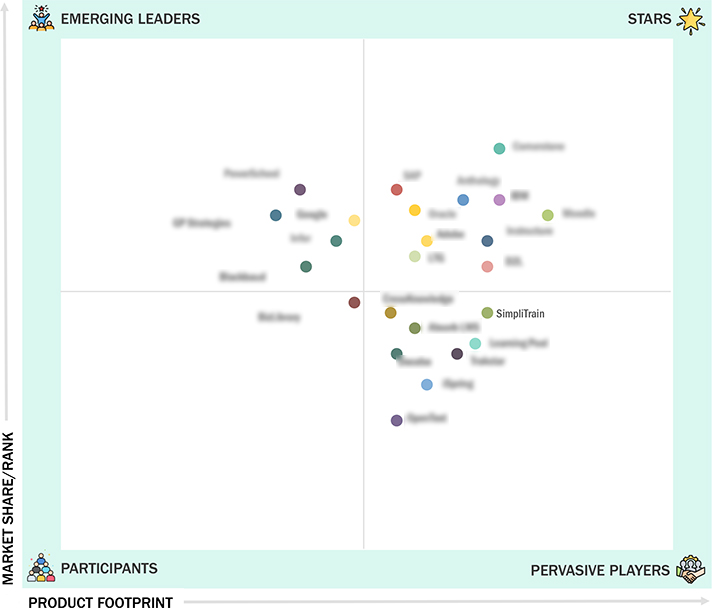
3.7 Company Evaluation Matrix: Key Players, 2025
3.7.1 Stars
3.7.2 Emerging Leaders
3.7.3 Pervasive Players
3.7.4 Participants
3.7.5 Company Footprint: Key Players
3.7.5.1 Company footprint
3.7.5.2 Regional footprint
3.7.5.3 Offering footprint
3.7.5.4 Organization size footprint
3.7.5.5 User type footprint
3.8 Competitive Scenario and Trends
3.8.1 Product Launches and Enhancements
3.8.2 Deals
4.1 CORNERSTONE
4.1.1 Business overview
4.1.2 Products/Solutions/Services offered
4.1.3 Recent developments
4.2 SAP
4.2.1 Business overview
4.2.2 Products/Solutions/Services offered
4.2.3 Recent developments
4.3 ANTHOLOGY
4.3.1 Business overview
4.3.2 Products/Solutions/Services offered
4.3.3 Recent developments
4.4 IBM
4.4.1 Business overview
4.4.2 Products/Solutions/Services offered
4.4.3 Recent developments
4.5 MOODLE
4.5.1 Business overview
4.5.2 Products/Solutions/Services offered
4.5.3 Recent developments
4.6 ORACLE
4.6.1 Business overview
4.6.2 Products/Solutions/Services offered
4.6.3 Recent developments
4.7 INSTRUCTURE
4.7.1 Business overview
4.7.2 Products/Solutions/Services offered
4.7.3 Recent developments
4.8 ADOBE
4.8.1 Business overview
4.8.2 Products/Solutions/Services offered
4.8.3 Recent developments
4.9 LTG
4.9.1 Business overview
4.9.2 Products/Solutions/Services offered
4.9.3 Recent developments
4.10 D2L CORPORATION
4.10.1 Business overview
4.10.2 Products/Solutions/Services offered
4.10.3 Recent developments
4.11 POWERSCHOOL
4.11.1 Business overview
4.11.2 Products/Solutions/Services offered
4.11.3 Recent developments
4.12 GOOGLE
4.12.1 Business overview
4.12.2 Products/Solutions/Services offered
4.12.3 Recent developments
4.13 GP STRATEGIES
4.13.1 Business overview
4.13.2 Products/Solutions/Services offered
4.13.3 Recent developments
4.14 INFOR
4.14.1 Business overview
4.14.2 Products/Solutions/Services offered
4.14.3 Recent developments
4.15 BLACKBAUD
4.15.1 Business overview
4.15.2 Products/Solutions/Services offered
4.15.3 Recent developments
4.16 SIMPLITRAIN
4.16.1 Business overview
4.16.2 Products/Solutions/Services offered
4.16.3 Recent developments
4.17 CROSSKNOWLEDGE
4.17.1 Business overview
4.17.2 Products/Solutions/Services offered
4.17.3 Recent developments
4.18 ABSORB LMS
4.18.1 Business overview
4.18.2 Products/Solutions/Services offered
4.18.3 Recent developments
4.19 LEARNING POOL
4.19.1 Business overview
4.19.2 Products/Solutions/Services offered
4.19.3 Recent developments
4.20 DOCEBO
4.20.1 Business overview
4.20.2 Products/Solutions/Services offered
4.20.3 Recent developments
4.21 TRAKSTAR
4.21.1 Business overview
4.21.2 Products/Solutions/Services offered
4.21.3 Recent developments
4.22 OPENTEXT
4.22.1 Business overview
4.22.2 Products/Solutions/Services offered
4.22.3 Recent developments
4.23 ISPRING
4.23.1 Business overview
4.23.2 Products/Solutions/Services offered
4.23.3 Recent developments
4.24 BIZLIBRARY
4.24.1 Business overview
4.24.2 Products/Solutions/Services offered
4.24.3 Recent developments


Company Profiles
Strategy, financials, growth, and SWOT
Market Insights
Visual quadrant of competitors and leaders
Benchmarking
Compare by product, region, and end-user
Lead Gen Add-on
Use the quadrant to attract clients
 Escudo Digital
 Oct 2026
Hong Kong Computer Emergency Response Team Coordination Centre
Oct 2026
AlphaStreet
Oct 2026
SecurityWeek
Oct 2026
Oct 2026
Hong Kong Computer Emergency Response Team Coordination Centre
Oct 2026
AlphaStreet
Oct 2026
SecurityWeek
Oct 2026

360 Quadrants is a scientific research methodology by MarketsandMarkets to understand market leaders in 6000+ micro markets
360 Quadrants is a scientific research methodology by MarketsandMarkets to understand market leaders in 6000+ micro markets
Email : [email protected]
Quick Links
360 Quadrants is a scientific research methodology by MarketsandMarkets to understand market leaders in 6000+ micro markets
 Company
 Headquarters
 Year Founded
 Holding Type